The Easy Access Pass
What is the Easy Access Pass, how to apply and how to use it in the parks
This page provides an overview of the priority pass at Disneyland Paris including:
What are the types of access passes at Disneyland Paris
Do I qualify for a Easy Access Pass?
How to apply for a Easy Access Pass
Is the pass physical or digital
Who can accompany the pass holder
The key differences between the priority pass and the easy access pass
Are there any other types of pass?
You can click on the headings to skip to that section.
Guide to the Easy Access Pass at Disneyland Paris
What are the types of Access Passes at Disneyland Paris?
Disneyland Paris offers two types of Access Pass for use in the Parks, the Priority Access Pass and the Easy Access Pass. The Priority Access Pass is issued if you have proof of disability from a list of accepted documents, and the Easy Access Pass is issued if you don't have any of the listed evidence for a Priority Access Pass but you do have one of 29 Specified Conditions, and have a Dr's letter signed and dated within three months of your trip confirming that.
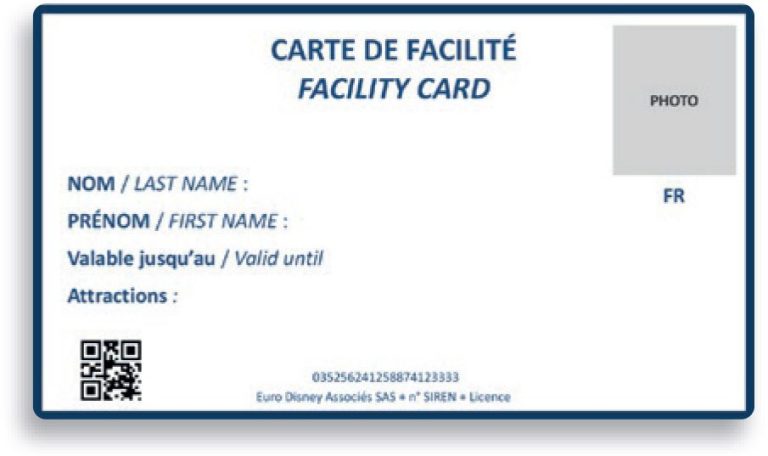
Both types of pass are credit card sized and have a photo of the pass holder. The Easy Access Pass also comes with a paper booklet for cast members to write down return times (see more below).
More information about the Priority Pass can be found here:
Do I qualify for an Easy Access Pass?
If you are not eligible for a Priority Access Pass you may be eligible for an Easy Access Pass, though if you are eligible for both you should apply for the Priority Access Pass.
To be eligible for an Easy Access Pass you must have one of 30 (well, actually 29) long term conditions, listed below.
Disneyland Paris do not offer the Easy Access Pass for temporary conditions such as a broken limb or recent surgery and instead they suggest you postpone your trip.
1. Debilitating stroke.
2. Bone marrow aplasia and other chronic types of cytopenia.
3. Chronic arterial disease with ischemic events.
4. Complicated schistosomiasis.
5. Chronic heart failure, chronic heart valve disease, serious heart arrhythmia, chronic congenital heart disease.
6. Chronic liver disease and cirrhosis.
7. Severe primary immunodeficiency disorder requiring long-term treatment, human immunodeficiency virus (HIV).
8. Type 1 diabetes and type 2 diabetes.
9. Severe neurological and muscular disorders (including myopathy), severe epilepsy.
10. Haemoglobinopathy, chronic constitutional/severe acquired haemolysis,
11. Haemophilia and severe constitutional haemostatic disorders.
13. Coronary artery disease.
14. Acute/chronic respiratory failure.
15. Leprosy.
16. Parkinson’s disease.
17. Inherited metabolic disorders requiring long-term specialised treatment.
18. Cystic fibrosis.
19. Acute/chronic nephropathy and primary nephrotic syndrome.
20. Paraplegia.
21. Periarteritis nodosa, acute disseminated lupus erythematosus, progressive systemic sclerosis.
22. Severe progressive rheumatoid arthritis.
23. Long-term psychiatric disorders.
24. Ulcerative colitis and progressive Crohn’s disease.
25. Multiple sclerosis.
26. Progressive structural scoliosis (where the curve is 25 degrees of more) through to spinal maturity.
27. Severe ankylosing spondylitis.
28. Organ transplant disorders.
29. Active tuberculosis.
30. Malignant tumour, lymphoma or haematopoietic cancer.
If you spotted number 12 is missing this is a condition that was removed from the list, which is based on a French government list.
How do I apply for an Easy Access Pass?
You cannot apply for an Easy Access Pass online, you can only apply when you are at the parks.
You can apply for your Easy Access Pass at the following locations:
- At Guest Services at the park entrances, these are former ticket booths and there are cast members int he area to direct you
- City Hall - On your left as you first enter the Disneyland Park under the train station, this is probably the busiest option on the list but they are also very experienced with passes so is a good place if you have issues or questions about your pass
- Studio Services - On your right when you first enter the Studios Park, this is usually quieter than City Hall but they are also experienced with passes
- At the concierge desk/reception when checking into a Disney hotel, this is Disney owned hotels only and doesn't include partner hotels or Villages Nature.
What proof do I need to bring?
You'll need to bring an original letter, dated within 3 months, signed by a Doctor stating that you have one of the 30 listed conditions, but Disney state it should not actually state which condition it is.
Most GP's in the UK will charge for a letter as it is a private service and they do not have to provide them, some may even refuse to issue them at all. If you are under a consultant at a hospital they may be able to provide a letter but again this is not something they have to do.
Is the pass physical or digital and what does it look like?
At Disneyland Paris the pass is a physical card and it is not digital. Because it is not digital it is not linked to your account or tickets and is not visible in the app.
The card is printed for you and is credit card sized with a photo of the pass holder. Alongside the plastic card you will recieve a paper booklet which is used to write down the return times for rides, so you need to have this and take it to each ride.
Sometimes the machines used to print the passes may not be working at the location where you go to collect it, in this case a paper version can be issued. If this becomes damaged over the course of your visit you can request a replacement at any of the pass issuing locations, though they may ask to see the evidence again. They can also issue additional booklets for the return time if yours becomes full.
How does the pass work and where can it be used?
The Easy Access Pass can only be used for rides (also listed as attractions in the Disneyland Paris App). It cannot be used for character meets, shows or for the viewing areas.
Alongside the card you will be given a booklet. You take the card and booklet to the ride/attraction entrance and the cast member will write a time in it to return. This time is equivalent to the current wait time for that attraction.
You can then go somewhere and take a seat, rest, browse in a shop, have a snack, or whatever you fancy until your return time, when you can then return to the ride and use either premier access or the accessible queue (the cast member will direct you).
You can only hold one return time at once so you can't go get another until you have used your current one.
Is it just for me, can anyone else accompany me?
The Easy Access Pass is for use by the passholder but they don't have to ride alone! (Although pass holders are free to ride alone if they want to, there is no requirement to have anyone accompany you).
You can take up to 4 additional people with you on rides. This does not need to be the same 4 people each time, but this number does include babies and toddlers under 3 who don't have a ticket.
If you have a larger group and you want to ride together one option can be to pay for premier access for any additional people where the ride has that option available, since easy access pass users will use the premier access queue.
What is the difference between the Priority Pass and the Easy Access Pass?
People often ask what the differences are between the Priority Card and the Easy Access Card, and which one they should apply for if they would qualify for both.
If you have a recognised disability (and the correct evidence) and it is due to, or you also just happen to also have a qualifying condition for the Easy Access Pass then you should request a Priority Card.
The key difference between the two is that the Easy Access Pass is primarily only for providing return times to attractions (rides) and cannot be used for any of the other accommodations described here for the Priority Pass, it can't be used for shows, viewing areas or for character meets.
Are there any other types of pass?
While Disney no longer offer any type of pass for temporary injuries or illnesses there is one other type of pass available, for expectant mothers, called the Bambi Band, or Bambi Pass. I use the term expectant mothers because that's what Disney use and if you search the website for Pregnant or Pregnancy it doesn't find any information!
You can collect this at the same locations as for the Easy Access Pass, and you need a letter or other evidence of pregnancy dated within 3 months (Disney state a medical certificate but I have heard that people have shown maternity notes or scan pictures with success).
You get given a wristband rather than a card, and it has the same benefits as a Priority Access Pass, but can only be used on rides that suitable for pregnant women.
I have heard that you can also use it to go on rides that are not recommended for pregnant women, but this is completely at your own risk. You cannot use it on rides which state pregnant women must not ride.
This page has been last updated in December 2025